Tuesday, April 19, 2011

42. Snuba, 4/14/11

Katrena and I went snuba’n. Many of you might ask, what is snuba? Snuba, invented in 1988, is a dive experience that combines the best of both snuba and snorkeling. It allows participants to go deeper than snorkeling using a shallow water dive system that makes it possible to dive as deep as 25 feet below the surface for up to 30 minutes without wearing heavy air tanks.

Snuba was created for those who enjoy the ocean and would like to experience the wonders of breathing underwater. Snuba is safer and easier than scuba and does not require certification.

A professional guide is with you the whole time. You progress at your pace, letting go of the raft and diving down when you choose to, and diving at the depth you prefer. You wear a lightweight harness that tethers you to the snuba raft on the surface by way of a 25' hose. The raft carries your tank on the surface and follows your every move. You breathe through a regulator, wearing a small weight belt, mask, and fins. Minimal equipment for maximum fun! Beginners are instructed in the proper use of the snuba gear and in a very short time you are enjoying the beauty and serenity of the underwater world. If you have ever wondered what scuba diving is like, there is no safer and easier way to find out than snuba. Many people have commented on the fact that snuba is easier than snorkeling. While you are snuba’n, you can expect to see coral reef here that is frequented by green sea turtles, octopus, and a great variety of tropical fish and marine life.

Let me tell you though, it is a little harder to get used to than one might think. We are always taught to breathe through our noses and not through our mouths. The first rule of snuba is to breathe through your mouth using your regulator. Our brains fight the urge to breathe underwater because every fiber of our being tells us to hold our breath underwater, but our guide told us to make sure and NOT hold our breath. Once you get used to the breathing part though, the rest is easy and oh so much fun.
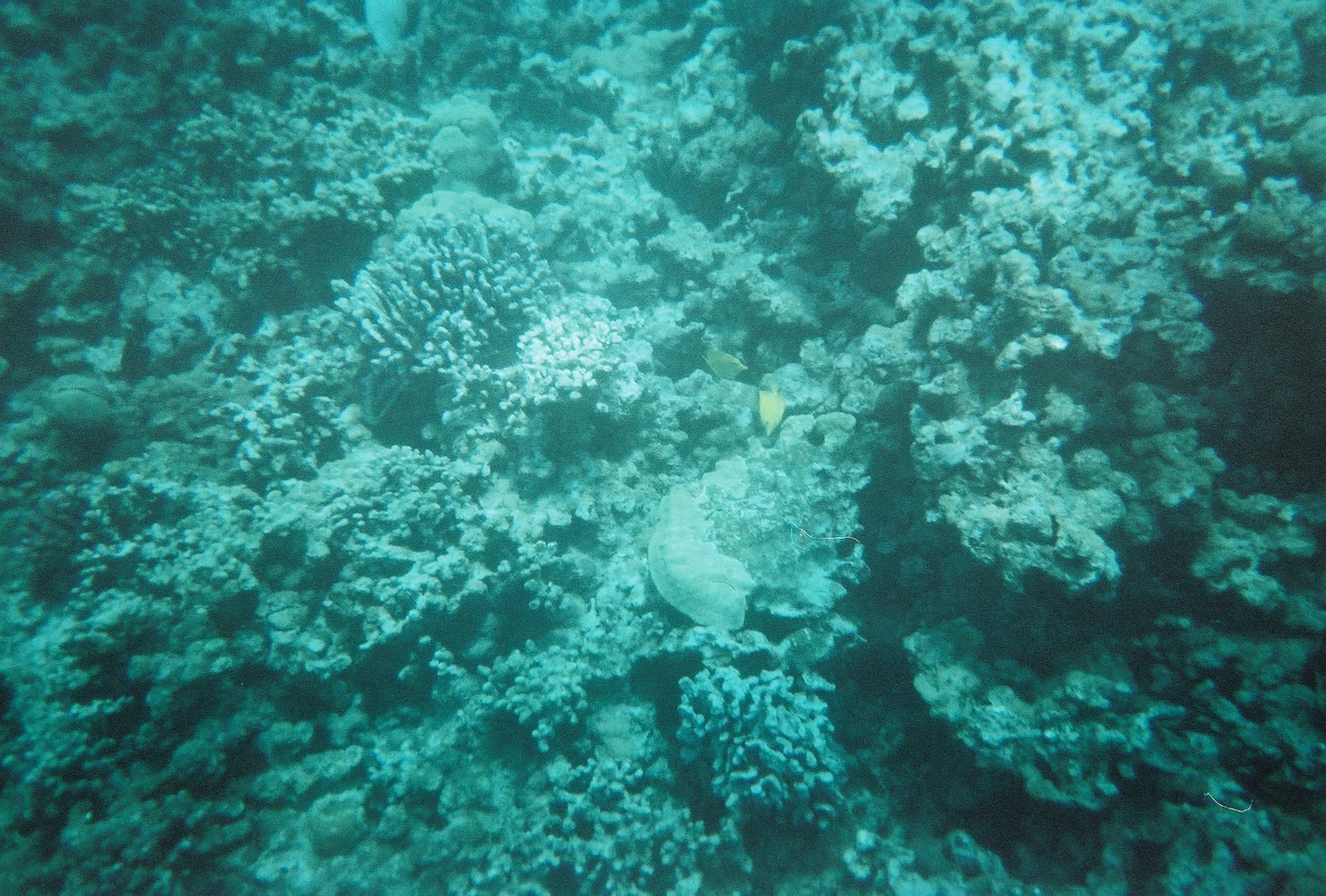
I only freaked out and panicked once. After much practicing on the surface of the water, I finally was ready to “dive.” The instructor began to dive, but as hard as I might try, I could not dive. The instructor finally came back and put another weight on my belt and that helped, but once again I came to a point that I could not seem to descend as deep as I would have liked. Finally, I started to descend down, BUT all of a sudden I just kept descending, even when I did not want to. Apparently, I was vertical (I learned one is supposed to be horizontal when diving and not vertical), and I starting sinking. Before I knew it, I was touching the bottom of the ocean, 25 feet down. This is when I freaked out and panicked. I saw my instructor but he was looking forward, not backward at me. I began to swim in circles thinking I was about to die when I remembered what the instructor told us if we needed to go to the surface – grab your 25 feet of hose that was tethering you to the raft above and SLOWLY pull yourself to the top – so that is what I did. After I got back to the top, caught my breath and regrouped, I was able to go back down. The pictures I took surely do not do justice to what I saw below the surface, the brightly colored fish, the coral, and the marine life. Sadly, about the time I finally got it all figured out, we had to head back.

Some of you might ask about Katrena’s experience…well, considering she does not like water in her face and she has never even been snorkeling, she did very well. She was able to keep her face in the water and was breathing through her regulator. Who knows, maybe next time, she will even let go of the raft.

Sunday, April 10, 2011

41. Oaks Park, 4/10/11

A trip down the midway is a trip through over 105 years of Portland family fun! Ride a pig, cat, or even a dragon on the 1911 Herschell-Spilman Carousel. Twist and twirl on carnival classics like the “Tilt-A-Whirl” and “Rock-o-Plane,” and fly 70 feet into the air on the ultra-modern Screamin’ Eagle. We forever hear that there is no such thing as a free ride, well I beg to differ. Here at Oaks Park there is a free ride for your little ones. There is no admission fee for the “kiddie” rides where big adventures await them.

Survivors of an earlier era. before Disneyland and Six Flags, before steel coasters went 50 mph, and rides were named for cartoons, movies, and superheroes, there were trolley parks. The parks were built by trolley companies at the end of the line in the late 19th and early 20th centuries as a way to get workers and their families to ride streetcars and railways on weekends. They had carousels, picnic grounds, and live entertainment, and they were often located by lakes, rivers, or beaches where visitors could take a boat ride or swim.

By 1919, just after World War I, there were 1,000 amusement parks around the country, and most of them were trolley parks. But as cars replaced trolleys, the streetcars and the parks faded away.

Even if you do not have a thing for bobby socks and malted milkshakes, it is hard not to be charmed by the attractions at Southeast Portland’s Oaks Amusement Park. For starters, it is one of the oldest continually operating amusement parks in the United States, and its quaint scale means that little legs will not get tired walking from one attraction to another. Moreover, its riverside location highlights the city’s natural beauty.

Today, only 11 trolley parks remain in operation, one of them Portland’s Oaks Amusement Park, which dates 1905. With a couple of exceptions, most of the surviving trolley parks are smaller, more family oriented, and substantially cheaper than big modern theme parks with high speed 20-story roller coasters. Some still let you pay by the ride, rather than charging hefty gate admissions than can add up to hundreds of dollars for a family. Many of them encourage you to bring picnics rather than banning outside food like some big parks do.

Portland’s Oaks Park is now run by a nonprofit organization that was established by the family that once owned the park, but the park was built by the Portland Traction Co. at the end of a rail line on the Willamette River, just before the 1905 centennial celebration of the Lewis and Clark Expedition.

Past exotic entertainment had included a roller-skating elephant and ostrich zoo, and John Philip Sousa performed at Oaks Park a dozen times. Then as now, a roller rink, one of the largest on the West Coast, was a park centerpiece, with live music from a Wurlitzer pipe organ. Oaks Park is thriving with 750,000 guests from spring to early October and 800 corporate picnics annually. It is also affordable: Parking is free, and you still pay by the ride.

Yes, by some Oaks Park may be considered cheesy, but I considered it fun!

Monday, April 4, 2011

40. Saturday Market, 4/3/11

Any weekend in Oregon without rain would be a good weekend to visit to the Portland Saturday Market. I have to say, this is not your garden variety swap meet. There is some real talent here. Ongoing since 1974, the Portland Saturday Market is the largest continually operating outdoor arts and crafts market in the nation. Centered in Portland’s historic Old Town, the market is one of the most popular shopping destinations for local handcrafted goods.

You can stroll down row upon row of local handcrafted items and homemade foods. The Portland Saturday Market – open Sundays too – is open on Saturdays from 10 to 5 and Sundays from 11 to 4:30 from March through Christmas Eve. Where else can you attend Festival of the Last Minute – Procrastinators Rejoice!

The Market offers a unique opportunity for customers to meet the artists as well as see one of a kind pieces created in the artist’s booth. With over 350 small businesses, live music, and a plethora of exotic foods, there is something that will satisfy everyone’s appetite. As one would expect, the types of crafts and artisan goods sold at the Portland Saturday Market vary widely. The market has strict rules on what constitutes a craft or artisan product so there is a definite “handmade” flair here. In other words, you will not be coming across booths selling unoriginal made in a factory somewhere. This rule makes and keeps the market real. I saw many treats: pets items, photography, wood crafts, baby gifts, body products, pottery, games, garden items, clothing, glass art, and jewelry to name just a few. One of the booths that brought the most fun has to be Spoonman...the picture says it all.

There are other artists at the market are, otherwise known as of course, the musicians. These folks draw a crowd and as expected, the style of music is varied. From folk, to blue grass, to rock and roll and even some metal, you can expect to enjoy many different kinds of music as you shop, eat, or people watch.

Of course, what day would not be complete without good food. The menu here was different, was varied, and offered a little bit of everything. The menu rotates as vendors come and go but many of these options are relative staples: Greek, Lebanese, Creole BBQ, Polish, Asian and Thai, Vegetarian, Healthy Mexican, Pacific Northwest style chowder, Guatemalan, Hawaiian, East African, as well as American fare such as burgers, chili fries, pizza, and more. You will also find several packaged foods such as roasted nuts, fudge, chocolates, spices, bakery items, and deserts.

As an extra treat, the cherry blossoms were in full bloom and absolutely beautiful. As a photographer, I could not get enough of those flowers, the photo ops, etc. I could have stayed there all afternoon, looking for that elusive “perfect” shot. I am truly blessed to live in a state and a part of the country that offers so many beautiful places to take in God’s beauty…I NEVER get tired of looking for that “perfect” shot…my journey continues and the next shot is waiting for me.

Saturday, April 2, 2011

39. Classic Saturday, 4/2/11

Classic #1: Breakfast at Tiffany’s with Audrey Hepburn and George Peppard. The names Audrey Hepburn and Holly Golightly have become synonymous since this dazzling romantic comedy was translated to the screen from Truman Capote’s best-selling novella. Holly is a deliciously eccentric New York City playgirl determined to marry a Brazilian millionaire. George Peppard plays her next-door neighbor, a writer who is “sponsored” by a wealthy Patricia Neal. Guessing who is the right man for Holly is easy. Seeing just how that romance blossoms is one of the enduring delights of this gem-like treat set to Henry Mancini’s Oscar-winning score and Oscar-winning Mancini-Johnny Mercer song “Moon River.” A near perfect blend of comedy, romance, and minor tragedy, Breakfast at Tiffany's is a must-see classic that, despite diversions from Truman Capote's original novel, remains his clearest statement on what it feels like to be young, ambitious, and on the make in a rapacious city full of hidden agendas.

Classic #2: The African Queen – The best loved of all adventure movies with two Oscar Awards for Best Actor and Lifetime Achievement of Cinematography, starring Humphrey Bogart and Katharine Hepburn. During World War I, a hard drinking river trader Charles and a prim missionary Rose are forced to take an adventurous river expedition together. Throughout the voyage, they encounter tropical hazards, nefarious German officers, and a surprising romance. Of course, the chemistry between these two actors is famous. Theirs is the quintessential love-hate relationship; other plot elements are secondary compared to what goes on between Rose and Charlie. It is what makes us care about the characters and what happens to them.

Classic #3: Some Like It Hot – When Chicago musicians Joe (Tony Curtis) and Jerry (Jack Lemmon) accidentally witness a gangland shooting, they quickly board a southbound train to Florida, disguised as Josephine and Daphne, the two newest – and homeliest – members of an all-girl jazz band. Their cover is perfect…until a lovelorn singer (Marilyn Monroe) falls for “Josephine,” an ancient playboy falls for “Daphne,” and a mob boss refuses to fall for their hoax. Nominated for 7 Academy Awards, Some Like It Hot is the quintessential madcap farce and “one of the greatest of all film comedies.” Some Like It Hot is far from a perfect film, but Billy Wilder took what might have been a rather banal story line and juiced it up into classic territory by squeezing Monroe, Curtis, and Lemmon into dresses and giving them some of the wittiest one-liners on film.

All three of these movies truly are “classics.” I have no doubt the much younger generation may not see them as the classics they have grown to become, but in their day these movies were cutting edge. I am glad that I took a lovely sunny afternoon and spent the time watching them.

Sunday, March 20, 2011

38. Newport Aquarium, 3/20/11

I know, most, if not all of you, have already visited the Oregon Coast Aquarium (OCA) at some point in your life, but I have not. I truly regret that I never took my boys when Keiko was still there. Today, though, I was able to experience personal encounters with sea life found on, under, and over the ocean – close to our Oregon shores. Natural animal habitats provided viewing opportunities, above ground and through underwater windows, enabling visitors to gaze into seldom seen worlds.


The Aquarium’s Passages of the Deep exhibit allows the visitor to literally immerse themselves in the ocean realm that exists right off the Oregon coast. A series of underwater walkways leads the visitor from the dark, quiet canyons of the Orford Reef, through the sparkling and teeming waters of Halibut Flats, and finally into the vast blue expanse of the Open Sea. As you pass through these three ecosystems, you symbolically move further into the Pacific Ocean, encountering vastly different animals along the way.


Sometimes known as a Musky Caiman, this is the smallest of the crocodilian reptiles (large males rarely grow longer than 5.2 feet) and can be found in the northern and central parts of South America, including Bolivia, Brazil, and Colombia. Like most crocodilians, the caiman has a heavily armored skin. Its head is narrower than other species, however, which is probably an adaptation that better enables the animal to burrow.

When visiting this habitat, you must linger for a moment and consider this fact: you are looking at the largest population of sea otters in the state of Oregon. This species was hunted to extinction in the Oregon wild over a century ago, with the last known individual being killed just off the Newport Beach in 1907. The economic value of the Sea Otter extends back to the very beginning of our nation. Today, this marine mammal is the focus of many different conservation and recovery efforts, particularly in California and Alaska.

There are many species exhibited in the Seabird Aviary. Some species, like the tufted puffin, sport breeding plumage or skin coloration that includes vivid colors and striking markings. The birds molt again in the early fall and replace their feathers with more drab colors for the rest of the year. Black oystercatchers are a shorebird species and live in rocky intertidal areas. They do not dive for fish, but chisel limpets, crabs, and mussels from tidepool rocks and break them open with their beaks. They are more graceful flyers than the relatively heavy-boned, diving seabirds, and are very vocal, using a series of shrill whistles and calls to communicate with each other.

A shoreline is how most human beings experience the ocean. Standing with your feet in the sand and staring out at the waves has inspired everything from epic poems to artistic masterpieces. It is from this vantage point that we can first experience the awe and mystery of the ocean. The Sandy Shores exhibit helps us not only recreate that awe-inspired feeling, but to understand the complexity of this teeming but narrow ecosystem where the land meets the water. Here, much of the life is hidden beneath the sand or in the cracks between rocks. Many surf zone animals bury themselves to escape the drying sun and the sharp eyes of shorebirds and marine predators. The animals of the Sandy Shores can also be so tiny they almost escape observation, but even the smallest still play a vital role in nature’s constant cycle of life.

At first glance, jellyfish may be so alien-looking to the human eye that it is hard for us to even think of them as animals. Jellyfish (or "jellies" for short) are an exceptionally old species. Surprisingly, they have changed relatively little in all that time. The Moon Jellyfish is one of ten nearly identical jellies in the genus Aurelia. In fact, the Moon Jellyfish and its relatives are so similar that you cannot tell them apart without taking a sample of their DNA. All of these jellies measure approximately 10 to 16 inches in diameter with thin tentacles that hang from below their nearly translucent bodies. Like other jellyfish, the Moon Jellyfish have the ability to deliver a sting through these tentacles, a feature which allows it to immobilize its prey such as plankton and mollusks. The sting causes little discomfort to humans, however, aside from producing a slight rash that will disappear after a few hours. If you wander the Oregon beaches after a storm, you will often find Moon Jellyfish washed up on shore.

When you visit our Coastal Waters exhibit, you may have to wait a moment or two to get close to the Sea Nettle display. Perhaps one of the most popular habitats in the gallery, these large jellyfish seem to have the ability to hypnotize us with their rhythmic undulations and the graceful spread of their lacy tentacles. Although jellyfish like the Sea Nettle can propel themselves using a form of jet propulsion where they squeeze water through the bells of their bodies, they cannot move quickly or pursue other animals. They must feed as they drift on the ocean’s currents, spreading their tentacles out like nets to catch fish and other unsuspecting prey. Once an animal has been immobilized by the Sea Nettle’s sting, special tentacles called “oral arms” begin digesting it even before it has reached the jellyfish’s mouth. Despite this potent sting, Sea Nettles present no real danger to human beings and are often eaten by seabirds and large fish. This by far was my favorite exhibit of the day.

Of course, what trip to the beach is complete without a stop at Dory Cover for some clam chowder as well as Halibut fish and chips. I have to say thanks to Jan for spending the day with me; I had a great time!

Sunday, March 13, 2011

37. The Kennedy School, 3/12/11

McMenamins Kennedy School has been the center of its Northeast Portland neighborhood since 1915. When class was not in session, the school served the community as a flood-relief shelter, meeting hall, and playground. The 1969-70 school year marked the start of busing in Portland, ending Kennedy's 54-year as a neighborhood school. Beginning this year, students were transported from other areas of the city to attend school at Kennedy, which brought about a significant diversification of the school's student body. It also marked the creation of the middle school system in Portland, resulting in the removal of grades 6-9 from Kennedy and other elementary schools. Kennedy Elementary closed in June 1975. Reasons for its closure included the school district's declining enrollment and the school's deteriorated condition (it was one of the district's oldest active schools by then). Beginning in the late 1975-76 school year, Kennedy was reopened as a temporary facility for other Portland schools undergoing renovation. After the 1979-80 school year, Kennedy School closed completely. Between 1981 and 1994, alumni and neighbors waged a battle against the school district to prevent Kennedy's School demolition. New uses considered for the school ranged from housing for the elderly to an indoor soccer facility; in 1994, McMenamins agreed to undertake renovation of the school.

The 35 guestrooms, formerly the school's classrooms, feature king and queen beds, abundant natural light, and original chalkboards and cloakrooms and start at $115 per night. While steeped in vintage charm, each room includes a phone and private bathroom. Your overnight stay also includes admission to the movie theater and soaking pool. The soaking pool is filled with gently heated saltwater and surrounded by gardens in an outdoor courtyard. The pool is open to overnight guests as part of their stay and to the public for a nominal fee. Recent run films are shown daily in the school's old auditorium, where guests relax on couches and chairs. Here you can freshly baked pizza and calzone as well as other menu items along with ales, wines, and spirits. They will even bring your order to your seat. The Principal's office has been turned into a gift shop. No space goes unused, the boiler room, formerly the custodians' lair, offers three TVs, pool tables and shuffleboard, along with a full bar, pizza, calzone, panini sandwiches, and more.

Once the school cafeteria, the Courtyard Restaurant is open daily for breakfast, lunch, and dinner. You can enjoy burgers, sandwiches, fresh salads, seasonal specials, and more, paired with handcrafted ales, wines, and spirits. On nice days, head to the outdoor courtyard, where the fireplace and gardens make it a great spot for relaxed meals and conversation.

Original paintings, wood panels, and other artistry decorate every room, fashioned from former classrooms, the library, auditorium, and gymnasium. You can rent space for everything from weddings to workshops.

It is a fun place to just go for dinner and enjoy some of Portland's "history," or it would be a great place to go for the night and take advantage of all The Kennedy School has to offer. I wish I would have taken my real camera instead of my phone, maybe the pictures would have done the facility justice, but I think you get the idea.

36. Vista House, 3/12/11

Majestic – It is the only word to describe Crown Point and the vulnerable Vista House. While the weather certainly did not cooperate with us, Jess and I did not let that stop us. After all, we do live in Oregon and have found that if you wait for “good” weather, you would miss out on a lot of wonderful opportunities. It was cold and wet when we arrived AND there was an unplanned wedding about to take place when we arrived. While it is a public building, out of respect for the couple, we waited outside and snapped a few pictures. When we were totally soaked, we moved our waiting to the car. The wait was certainly worth it. The building is fantastic. I can certainly understand why a couple would want to marry inside the building. The lighting is amazing, the history compelling, and the view…stunning.

Vista House serves as a gateway to the adventures awaiting you at the many Oregon State Park properties that dot the south side of the mighty Columbia River. The vista from Crown Point affords a breathtaking display of the Columbia River Gorge, even more so on a clear day. The Historic Columbia River Highway unfolds below: a graceful ribbon of gentle curves that belies the sophisticated engineering and painstaking design of this, The Kind of Roads, as it was known.

Since 1918, this regal sight has enthralled millions of travelers. From its surrounding vantage point 733 feet above the Columbia River, sightseers and photographers have enjoyed one of Oregon’s most inspiring views.

Few places combine nature’s wonders and human architectural brilliance so majestically. Crown Point is a promontory shaped by the same volcanic lava flows, floods, and winds that created the Columbia River Gorge. The site was designated as a National Natural Landmark in 1971. It has been protected as a state park property since 1938 when Multnomah County and the city of Portland gave the building and adjacent land to the state for park purposes.

The Vista House was built as a rest stop observatory for travelers on the old Columbia River Gorge Highway and as a memorial honoring Oregon’s pioneer—particularly those who made their way down the Columbia River. It has been described by its architect as “a temple to the natural beauty of the Gorge.”

Financing the building of the Vista House was challenging. No state dollars were available, leaving the project dependent on funds from Multnomah County and donations from private parties. The total cost of construction—completed on May 1, 1918—was about $100,000. The structure is 44 feet in diameter and 55 feet high. The roof, which for many years was topped with a copper crown, has been restored to its original surface of matte-glazed green tiles.

I can see why this amazing spot is photographed so often; it truly is majestic. I only hope that some day I can revisit the site in “good” weather only so I can do it justice in my photography. Thanks Jess for sharing this with me.

Every January, it seems like everyone is buzzing about New Year’s resolutions. We hear about ambitious goals and “new year, new me” aspira...