Tuesday, August 22, 2017

Great American Eclipse

What is a Total Solar Eclipse? A solar eclipse occurs when the moon passes between the sun and the Earth. The moon appears to completely cover the disc of the sun. By blocking the sun's light, the moon casts a shadow that turns day in an eerie twilight here on Earth. Eclipses occur because of the special coincidence of the moon and sun being the same size to our eyes. The sun is 400 times wider than the moon, but it is also 400 times farther away, so they appear to be the same size in the sky.

Why is this called the “Great American Eclipse?” This is the first total solar eclipse that is only visible in the U.S. and no other country. It will be the first total eclipse visible only in the USA since the country was founded in 1776. Everyone in the U.S. will see at least a partial solar eclipse; however, only people in the “path of totality” will see a total solar eclipse. The shadow began its travel in Oregon. At 3,000 miles per hour, it took about 12 minutes for the shadow to speed from the Oregon Coast to the Oregon-Idaho border. The entire trip from Oregon to South Carolina will lasted only 90 minutes. The path will cross parts of 12 states: Oregon, Idaho, Wyoming, Nebraska, Kansas, Missouri, Illinois, Kentucky, Tennessee, Georgia, North Carolina, and South Carolina.  The next total solar eclipse here in the U.S. will be on April 8, 2024, which will be from Texas to New England.


It is astonishing how fast the shadow moves, barreling towards you like a freight train. As the shadow engulfs you and you first notice the amazing light, as if sunset is happening on the horizon 360 degrees around you, the temperature drops, the air becomes still, and everything seems unusually quiet. Watching through your “eclipse glasses” you see the moon first kiss the sun and watch in amazement as more and more of the sun’s disc is covered. Just as the moon covers the sun you hope to have a fleeting glimpse of Baily’s Beads, the bright glow of lights on edge of the moon, caused by the sun peeking around mountain peaks on the moon. And then it happens! Totality. The moment you have been waiting for, when the moon obscures the sun and darkness descends. Only now is it safe to remove the eclipse glasses and look at the sun. The corona glows and dances around the black sun, stars are out and you find you are forgetting to breathe much less press the shutter. In that moment, as I stared at the sky and was caught in God's awesome wonder, my brain froze, I got goosebumps...I forgot what camera settings I needed to capture that moment in time...I was totally lost. After a few seconds, I snapped out of it and realized I needed to get the filter off of my camera and quickly as totality does not last long, 1 minute and 16 seconds in Woodburn is all. I took a LOT of pictures trying to capture each and every phrase of the eclipse, I only caught a couple of clicks of totality, and while none of them are that good, that picture is forever etched in my mind and nothing can take it away from me so my snapshots will have to be a reminder of that moment that there are no adequate words to describe.

Saturday, May 27, 2017

Grief Has No Expiration Date

I have met so many people in these last 20 years who never knew me as the married woman I once was, as a mother of two teenagers with a husband who was my partner in a life we chose to make together. With the exception of family, most of these people never knew who Joe was.

Losing a spouse, or a child, or a father or mother, or a sibling when you are young, is a loss that shapes your whole world and colors it a shade darker than the life you had before the loss. I want to say something that our death-denying culture makes me feel a little ashamed to say: Even though I can now go for a day, perhaps, without thinking about Joe, I do not know if I will ever make it through a day without thinking about the future I lost when he died. I know I will always feel bad that my sons do not have Joe here with them to be their father.  What they are missing by not having him here cannot be counted or measured; it is a vast emptiness where years and years of his amazing love, wisdom, and patience could have been.

Twenty years of memories, graduations, special people, weddings, grandchildren, birthdays...life's events...have come and gone. Grief does not end; however, you do learn how to cope with it ever so slowly, and you will miss that person in your life that is gone forever. I have had 20 years of milestones come and go that I could not share with Joe. He will always be missing. As amazing as all these events in my life have been, they were bittersweet because I was not able to share them with my best friend.

Certain things need an expiration date; milk, eggs, mayonnaise, meat, fish…there is a time we need to be done with them, and throw them away…I get all that, but does grief have an expiration date? For some reason, there seems to be an acceptable shelf life—6-12 months—and then grief should be off the shelf, out of the home and permanently removed with the weekly trash service. If it was only that simple…

The “grief expiration date” myth must come from people who have never experienced a close death – otherwise, they would know the truth. Everyone fears facing such a loss. They are hopeful that should death touch their world, it will only take 6-12 months to recover. No one wants someone they love to die. So, until faced with the reality, it is easier to think ‘this won’t happen to me, AND if it does it will only be bad for a finite, short amount of time and then…there is an expiration date and it is magically all gone.’ What a wonderful world that would be.

I have heard time and time again there is a societal expectation to “get over” grief in 6 months, and at the longest, a year. Those who are not grieving believe it, and often those who are, also believe it – this sets grieving people up for false, and ultimately disappointing, expectations.

The one year mark looms like some golden carrot over the heads of those who are grieving. It is a symbol of hope that if they make it to the one year mark they will be in a much happier and pain-free place. The reality is they will not be over it, nor should they be. If someone spent years loving another person, the pain of that person’s death simply will not be removed due to a date on the calendar.

The opposite actually might happen – people who are grieving may feel even more pain in year two because the initial numbness, which often serves as a protective barrier at the onset of loss, has worn off and they begin experiencing the full intensity of their feelings and grief. This is accompanied by the realization that life with loss is their “new normal.”

I remember beating myself up and doubting how well I was coping. If you allow yourself to believe there is an expiration date for grief, you will start to think you are not doing well if you still miss your loved one 5, 10, 20, 40 years after the loss. In reality – it is normal, and it is okay.

This is what I know to be true:

Grief IS a life-long journey; an emotional handicap you get up and live with every day. It does not mean you cannot lead a happy life, but it is a choice and it takes work.

The frequency and intensity of those grief pangs/knives should lessen over time, but the reality is every now and then for the rest of your life, you will feel those pangs. Everyone grieves at their own pace and in their own way. There is no one way to grieve, and no certain order, and no timeline. There is definitely not an expiration date.

Grief WILL take on different forms in different people. Not everyone cries; others cry all the time. Some exercise a lot; others talk about it a lot; many seek counseling or join a support group and enjoy the company of a good and understanding listener.

If years after your loss, thinking of your loved one missing a special day or milestone in your life, makes you sad, puts you in a funk, or makes you cry, do not beat yourself up. Allow yourself the ability to grieve the loss of memories not created. As long as the frequency and intensity of grief eases—even if it is ever so slowly over time—you are coping in positive ways. Alternatively, if years after the loss, you cannot bear the mention of your loved one's name, you sleep all day, you are not participating in your normal everyday activities, you do things to “numb” or escape your grief, those are warning signs that you are not coping well, and should seek the assistance you need to begin healing.

Grieving in a healthy manner, taking steps to move forward, and rebuild your life with a new normal, does not mean you will not have those tough days or tough moments.

There is no expiration date. Grief never fully goes away. That does not have to mean you cannot and will not live a happy and productive life. What it does mean is the love you shared with loved ones lost, does not have an expiration date either. Live Your Life. I am not saying you need to move on from grief, but maybe it is time to move forward; there is a difference. Live your life as a tribute to those that are gone. Try to be the best version of yourself. This is very hard when you have lost someone so important. After a while, I found it put my life into better perspective. I was able to distinguish between what was important and what was not. It is still a work in progress that I take day by day.

Everybody’s path in grief is different, so be gentle with yourself. Find what is right for you to get through this tough time. Remember what is important in life and to let go of what is not. Hug your loved ones a little tighter, kiss them one more time. You can never say “I love you” too many times. Life is short. Live your life!


Saturday, May 6, 2017

Failure

2016 was the first year in many that I did not complete many of the goals that I had set for myself and I considered that a failure.  However, as I started to ponder my failure in not completing the goals I had set for myself, it gave me time to reflect, and this is what I found...

Success is not final, failure is not fatal: it is the courage to continue that counts.
You know the feeling. It is that gut-sinking, I am-an-idiot, I will-never-amount-to-anything feeling and it is awful. There is no getting around it, but failure does not have to crush us. In fact, it can be an asset to us if we will let it.
One of the strongest indicators of how failure impacts us long-term is how we respond right after it takes place. Research shows the key response to know if a person's failure will lead to further tragedy or turn to success is simply this: Do they own the failure? In other words, when we respond by saying, “I’m so sorry. I made a mistake. This was my fault. I see where things went wrong,” that sort of thing, failure acts like one of life’s best teachers. We learn from our mistakes and move on. When we try to pass the buck — when we make excuses for ourselves, blame other people, or try to avoid the natural consequences of our actions, the results are the opposite. Our failure snowballs into more failure. When we respond to failure like — well, like it’s a failure — we are much less likely to recover from it.
Because I can only receive what failure has to teach me if I am willing to fully embrace the failure itself, when I am willing to accept the fact that failure occurred, I also get the positive lessons failure teaches. Some failures are bigger than others, some are more public than others, some are more humiliating, some have a greater stigma around them. But in learning to own my failures, admitting them, even embracing them, I am much more likely to get the results I want. The next time I think I have failed miserably, I will remind myself of the amazing benefits failure can bring. The greater the failure, the greater the potential for reward. I might fail, but failure does not define me.
The ultimate goal is that I can finally make peace with my failures — past, present and future. Not only will I recognize it does not define me, I will also be able to rest in knowing failure does not need to set me back. Failure can be one of life’s great teachers; it is nature’s chisel that chips away at all the excess, stripping down egos as it molds and shapes us through divine intentions. Without failure, I would be less capable of compassion, empathy, kindness, and great achievement. It is through failure that we learn the greatest lessons that life could teach us.
Failure Lesson #1: Experience
The first important lesson gained from failure is experience. What happens when we fail? When we go through something and can walk away with firsthand experience, it helps us to develop a deeper understanding for life. It completely alters our frame-of-mind through the induction of pain. It makes us reflect on the real nature of things and their importance in our lives, transforming and improving our future-selves.
Lesson #2: Knowledge
Failure brings with it important firsthand knowledge. That knowledge can be harnessed in the future to overcome that very failure that inflicted so much pain in the first place. Nothing can replace the knowledge gained from failure. When Benjamin Franklin famously failed nearly 10,000 times to create a commercially viable electric lightbulb, with each failure, he gained the knowledge of just one more avenue that did not work. It was the accumulated knowledge developed from nearly 10,000 failed attempts that ultimately led to his success.

Lesson #3: Resilience

Failing in life helps to build resilience. The more we fail, the more resilient we become. In order to achieve great success, we must know resilience. Because, if we think that we are going to succeed on the first try, or even the first few tries, then we are sure to set ourselves up for a far more painful failure.

Lesson #4: Growth

When we fail, we grow and mature as human beings. We reach deeper meanings and understandings about our lives and why we are doing the things that we are doing. This helps us to reflect and take things into perspective, developing meaning from painful situations. Life is designed for us to grow and improve. From the very genetic fibers that make us into who we are as individual persons, into the fabric of society on a global scale, growth is a fundamental part of us. Without growth, we could not improve life on every front.

How to Recover from Failure

There are many ways to recover from failure. Once I understood what failure is, and how it is meant to serve me rather than hinder me, I freed my mind and opened your heart to experience the joy of failure. Joy? Yes – Joy. When I am experiencing failure, it is hard to recognize the importance of it. I cannot see the forest through the trees, so to speak, when there is a fire threatening to burn the whole village down, but that is what I must do.

#1 – Ignore the Naysayers

When you fail, surely there will be the people telling you, “I told you so,” and, “You should have listened to me.” Ignore those people. Ignore the naysayers. Living a life that’s completely safe all the time, is not really living.

#2 – Understand and Realize that it is Okay to Fail

One of the best ways to recover from failure is to understand that it is quite alright to fail. It’s okay to fail, but it is not okay to give up. Success will taste so much sweeter when you reach it. Pushing forward and not giving up is quite possibly one of the best ways to recover from failure. Remember, it’s not true failure unless you throw in that proverbial towel and wholeheartedly give up forever. Failure will take you on a journey that you might not want to go on. But, the reality of the situation is that those journeys will help to mold and shape you into a better person. Recovering from failure becomes far more effortless with the knowledge and experience of that failure under our belts, and there is simply no way forward in life without failure.

#3 – Using Failure as Leverage

If you have failed in life, you can use that as leverage to not only recover from it, but to help propel you forward in the future. Failure can be a great a platform for growth that is simply unmatched. To leverage your failures, you have to illuminate them to your mind. Write out what you failed at and why you failed. How will you learn from the past to help shape a bigger and brighter future? Failure is not the end of the road as long as you do not give up. If you still believe in your goals, you can use the failure as leverage to push past the old limitations of your past.

#4 – Revisit Your Goals

Did you have clear and concrete goals in the past? Did you set your goals the SMART (specific, measureable, attainable, realistic, timely) way? Revisit your goals from the past and look at just how clear you were with your goals. Were they precise and exact? Did you visualize them in your mind? Sometimes, failure results from not setting goals the right way. Not only must we set goals the right way, but we must track and analyze them on a monthly, weekly, and daily basis. To recover from failure, revisit your goals and redefine them. Spend the time necessary to analyze and adjust where necessary.
“I hope that in this year to come, you make mistakes, because if you are making mistakes, then you're making new things, trying new things, learning, living, pushing yourself, changing yourself, changing your world. You're doing things you've never done before, and more importantly, you're Doing Something. So that's my wish for you, and all of us, and my wish for myself. Make New Mistakes. Make glorious, amazing mistakes. Make mistakes nobody's ever made before. Don't freeze, don't stop, don't worry that it isn't good enough, or it isn't perfect, whatever it is: art or love or work or family or life. Whatever it is you're scared of doing, Do it. Make your mistakes, this year, next year and forever.” ~ Neil Gaiman

Saturday, March 11, 2017

UFOs (UnFinished Objects)

Starting a new project is like falling in love. It is exciting, emotionally arousing, infused with the natural motivator of novelty. Perhaps we even get obsessive about this new activity. We image it as "all good" and do not pay much attention to potential obstacles, negatives, or challenges we may soon face.

Then, after some time goes by, the activity or book or lessons (or whatever) turns into harder work than we expected. It takes longer to complete than we had hoped, or there is some tedium and drudgery involved. We realize we are not sure about the next step. Stuck, we grind to a halt.

Not that we recognize that we have essentially quit trying. No, we just put off the "getting back to it" until such a time as we imagine it will be effortless again. This sort of procrastination may or may not be fueled be perfectionism and the fear that the next steps may not be excellent enough.

Let's talk about UFOs. (That is craftspeak for unfinished objects; in other words, a craft project you started but never finished.) Most of us have at least a handful of unfinished projects: a half-written novel on our virtual shelf, a blog that never made it past the first three posts, a body that is not quite as healthy or fit as we want it to be, craft projects left undone, etc. Sometimes we made conscious decisions to put aside these projects when we realize they are not worth the time or something else is more important. But most often, unfinishing is not so much a choice as a result as of a lack of discipline.  Without discipline, you will not finish anything that matters.
Discipline is not all that important when you start a project because the excitement and adrenaline and potential are enough to drive you forward, to keep you making progress. This beginning stage is when each endeavor is typically the most fun; it is new, it is challenging, it is enjoyable; however, the longer you work on a project - especially a creative one - the more difficult it becomes to stick with it. Once you pass through the initial stage of excitement, you will enter into a phase that is far more challenging.

Finish The Projects You Have Started Or Call An End to Them


I realized a source of clutter in my house, and a significant drain on my energy is the uncomfortable presence of unfinished projects. Every time I see evidence of an unfinished project, I get a jolt of annoyance or guilt. The thought "I should finish that..why haven't I finished that" makes me flinch.
Unread magazines. Half-read books. Half-completed craft projects. I decided that one of my 16 goals for 2016 was to finish an unfinished project a month or put an end to it. I wanted to get them out of my way, one way or another.
I am lucky, though, because my half-finished projects do not make much of a mess, or at least you cannot see them. I have friends with bedroom corners and dining room tables that permanently house half-built Lego castles, dusty piles of recipes, or scrapbooks with half the pages filled in.

Unfinished projects are irritating in themselves, and they also contribute to clutter, because it is so tempting to leave an unfinished project out in the open, as a reminder to finish it, but then it does not get finished! For days, weeks, months!
For me, one of the most persistent, nagging, draining, unfinished tasks is dealing with photos. I enjoy the process of making scrapbooks, but if I do not keep up with it, I can get overwhelmed really quickly or I will have to deal with a million photos at once. I love looking at photo albums, and I know that in the long run making these photo albums will bring great happiness. Happy memories of the past are an effective way to make me happier in the present. (Thus turkey hat was one of those projects that looked better in theory than finished; ever had one of those?)
I went through my entire house looking for unfinished projects, and I pushed myself to either finish them or call an end to them. They were weighing me down. How about you? Have you ever felt this way about an unfinished project? I would encourage you to either finish it or call an end to it. You will feel accomplished either way. (This bib was a project that I started more years ago than I can remember - it is a counted cross stitch. It was supposed to say "Spit Happens" I would need a magnifying glass to do it now. The only project I threw in the garbage without finishing.)

Tuesday, January 24, 2017

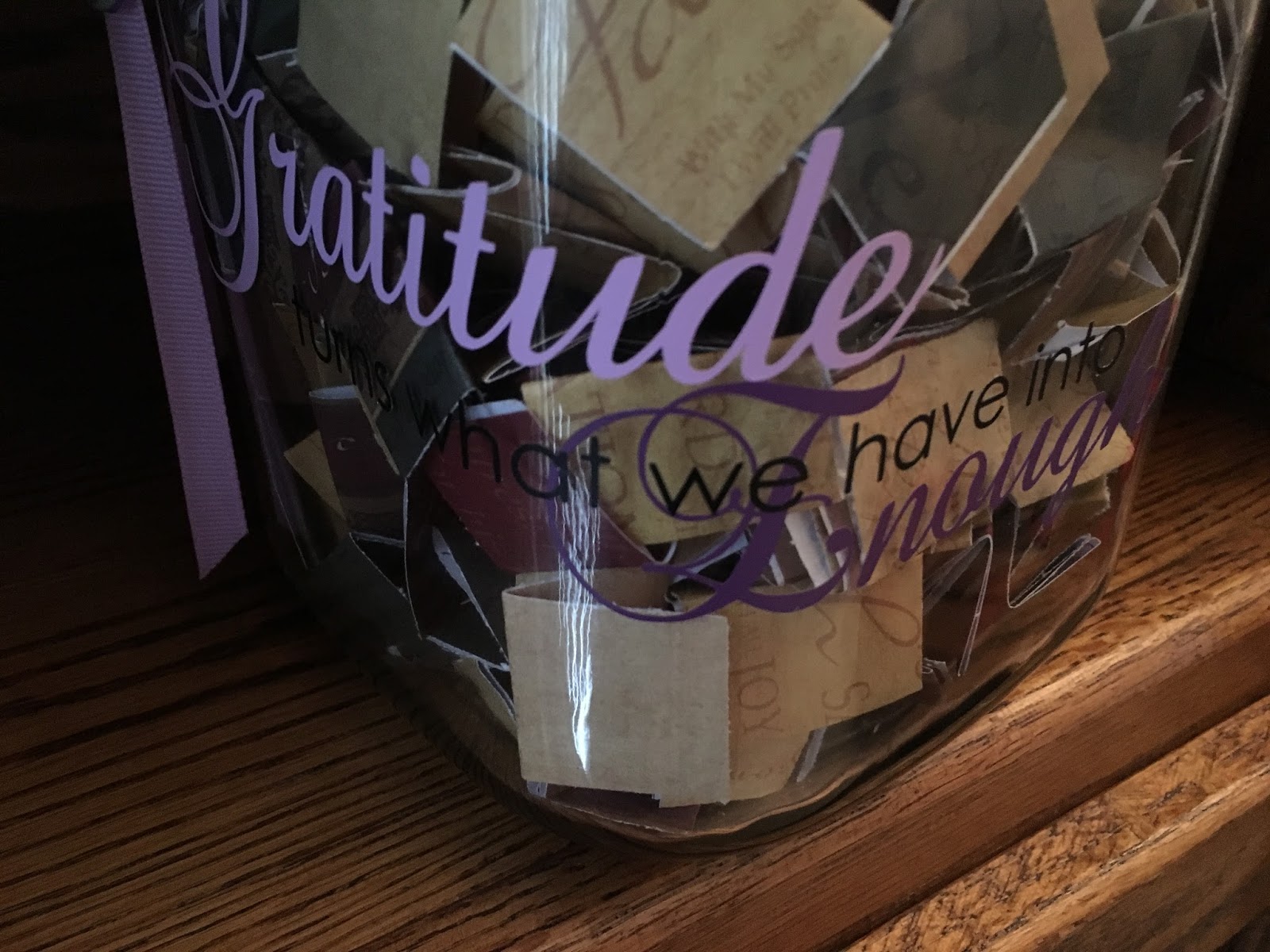
Gratitude - turns what we have into Enough

As most of you know, each year I pick a few year-long projects that I work on throughout the entire year. One of my 16 goals for 2016 was a Gratitude Jar. As I chronicled my thoughts, I had a meaningful reminder of the everyday things that make my life unique and wonderful. I will admit that there were days that challenged me; challenged me to be as good as I can be, to be thankful for the blessing of another day even when I felt that everything had gone wrong and that I had not lived up to my full potential. For this very reason, the Gratitude Jar. It made me stop for a few moments each day to think about one thing or moment or deed that I felt grateful for on that particular day. This helped me realize that
each day IS a gift.

We go through life hoping we will find the prize – the whole, perfect loaf of bread if you will, but while we are focusing so intently on that goal, we are missing all the crumbs, walking right by them. If we would just gather those crumbs, they would add up to a full loaf before long and feed us in the same way. I began trying to see and appreciate all the crumbs in my life. There were so many little things that mattered – meeting a friend for coffee, watching my grandchildren play, enjoying the perfection of peaches in season at the farmers' market. 

As I became practiced at noticing the little things to be thankful for, the bigger things began to come into focus as well. Some of them had been there all along, but I had not been able to see them for what they were: important learning experiences that were teaching me more about who I am, how I relate to others, and what I want out of life. Yes, even those parts of my life that I had not imagined or wanted also helped me to see the person I really am, and lead me into an even better future. I could learn to be thankful for it all.

* Gratitude puts situations into perspective. When I can see the good as well as the bad, it becomes more difficult to complain and stay stuck. 
* Gratitude helps me realize what I have. This can lessen my need for wanting more all the time.
* Gratitude strengthens relationships, improves health, reduces stress, and, in general, makes me happier.

Both the years and experiences have brought me here to where I stand today, but it is the thankfulness that opened the windows of opportunities, of blessings, of unique experiences to flow my way. I am also very thankful for the people, for the ideas, for the chance to work and labor, and to produce results, all of that has brought me to this place. I am grateful for it all.

Gratitude means thankfulness, counting my blessings, noticing simple pleasures, and acknowledging everything that I receive. It means learning to live my life as if everything were a miracle, and being aware on a continuous basis of how much I have been given. Gratitude shifts my focus from what my life lacks to the abundance that is already present. To say I feel grateful is not to say that everything in my life is necessarily great. It just means I am trying to be aware of my blessings.

I took for granted the good that was already present in my life. I began to start finding joy in the small things instead of holding out for big achievements–before allowing myself to feel gratitude and joy. Another way to use giving thanks to appreciate life more fully is to use gratitude to help you put things in their proper perspective. I have found that when things do not go my way, I need to remember that every difficulty carries within it the seeds of an equal or greater benefit. In the face of adversity I need to ask myself: “What is good about this?” “What can I learn from this?” and “How can I benefit from this?”

Once I became oriented toward looking for things to be grateful for, I found that I began to appreciate simple pleasures and things that I previously took for granted. Gratitude should not be just a reaction to getting what I want, but an all-the-time gratitude, the kind where I notice the little things and where I constantly look for the good even in unpleasant situations. I wanted to start bringing gratitude to your experiences, instead of waiting for a positive experience in order to feel grateful. 

If you are inspired to create your own gratitude jar this year, if you stick with it, you will quickly see that it is more than a fun craft project. Here are a few lessons to keep in mind if you decide to adopt this practice.

1. Gratitude is a verb - While it is one thing to see a photo of a gratitude jar and think ‘How cute! I should do that!’ it is a completely different story when it comes to actually sitting down and expressing the reasons why you are grateful. Gratitude is deeper than an ‘attitude’ or filling a jar with pieces of paper. Through this process, I learned how much it demands you to be more present every day. Think about how often our minds drift to how much we do not have and how far we have left to go. Take a moment and think about what you have right now. The wisdom that you have, how far you have come and notice the difference in how you feel.
2. Seek out the lessons during the hard times - It is easy to feel grateful when everything is going well, but what do you do when you are having a bad day? Trust me, there will be days when you do not want to write anything and that is okay. Sit with that feeling and write about that instead. During the periods when I felt really down or round myself wanting to resist the process I had to dig deep and ask myself - 'How do I feel in this moment? 'Why do I feel this way' or 'What am I learning?' Looking back now as I read the entries, I am proud that I let myself feel and express my emotions instead of glaze over them.
3. Do not try to be perfect - If you miss a day, it is not the end of the world. You do not have to ‘keep up’, or write a certain quota per day. This is a record of your life and you do not need to impress anyone. Author your own story.
4. Create your own rules - When you start your jar you may be tempted to create or follow a set of rules. If you find yourself thinking: You should write at least 3 things you’re grateful for each day; Don’t open your jar until Dec 31st; Only record your happy moments. Forget the ‘rules’ and do what works for you. If the picture of the jar that you saw on Pinterest says that you have to wait a year before reading what’s inside and you don’t want to, then don’t. Break the rules and create your own. Your jar. Your life. Your Way.

My outlook on life has shifted. A quick glance at my Gratitude Jar reminds me that life is full of wonderful things to be grateful for and I have the strength and support to overcome anything. Appreciating yourself for your strengths AND your imperfections (not in spite of them), allows you to find a sense of belonging and to feel more connected to life. Sometimes it is the simple things that make life wonderful: the beautiful sunrise, fresh strawberries from a farmer's market, a smile from a stranger, or an encouraging text from a friend. Taking time to appreciate those moments of joy helps you to cherish your life and yourself.

After this year, I am viewing things in a new way. I have a renewed appreciation and a sense of not taking things for granted. I am thankful for the things I have as well as the things I no longer have. These are my teachers, and I am blessed to have them in my life. I would love to hear about the challenges that have made you more grateful for life. 

Monday, January 2, 2017

My Life Verse Is.../My Word is...

Hebrews 13:5 - New King James Version (NKJV): Let your conduct be without covetousness; be content with such things as you have. For He Himself has said, “I will never leave you nor forsake you.”

Adam was in paradise, yet not content; some angels in heaven were not content; but the apostle Paul, though humble and empty, had learned in every state, in any state, to be content. Christians have reason to be content with their present lot. This promise contains the sum and substance of all the promises; "I will never, no, never leave thee, no, never forsake thee." In the original, there are no less than five negatives put together, to confirm the promise: the true believer shall have the gracious presence of God with him, in life, at death, and for ever. Be content with what you have, because God has said, "Never will I leave you; never will I forsake you."

I feel this verse isn't saying that one should never be ambitious about earning more money. The point is not about trying to either earn a living or even about financially doing well in life. The point is about contentment. It is a human desire to want more. In fact, most advertising is based on the fact that people are never satisfied with what we already have. This verse is also not saying that one has to take a vow of poverty to be a good Christian. The issue is about contentment in life. How do we be content with what we have? It starts by letting go of jealousy. That is why the 10th Commandment is to not desire our neighbor's "stuff". The idea is to learn to have contentment in life while still being ambitious to accomplish our goals. One can go through life either thinking, I need more to be happy, or I can learn to be content with what I have. There is nothing wrong with being ambitious or trying to earn more. The challenge in life is to say, What if I do not make any more, can I still be happy with what I currently have?

I will never leave thee, nor forsake thee - These words were spoken to Joshua in Joshua 1:5: "As I was with Moses, so will I be with thee; I will not fail thee, nor forsake thee." They were spoken also by David to Solomon in 1 Chronicles 28:20: "David said to Solomon his son, Be strong and of good courage, and do it: fear not, nor be dismayed; for the Lord God, even my God, will be with thee; he will not fail thee, nor forsake thee." There are no less than five negatives in this short sentence, and these connected with two verbs and one pronoun twice repeated. To give a literal translation is scarcely possible; it would run in this way: "No, I will not leave thee; no, neither will I not utterly forsake thee." Those who understand the genius of the Greek language, and look at the manner in which these negatives are placed in the sentence, will perceive at once how much the meaning is strengthened by them, and to what an emphatic and energetic affirmative they amount.

This promise is made to those who are patiently bearing affliction or persecution for Christ's sake; and may be applied to any faithful soul in affliction, temptation, or adversity of any kind. Trust in the Lord with thy whole heart, and never lean on your own understanding; for he has said, "No, I will never leave you or forsake you.” 

Indeed, God has NEVER left me or forsaken me!


Truth, like knowledge, is surprisingly difficult to define. I am not going to define truth, I am just going to say that my year was based on honesty and genuineness. New hope arose and made me very happy. This word guided me through 2016! It supported me in my daily struggles and situations that at times appeared hopeless. This word always showed me the silver lining so that I do not ever need to worry.

Monday, December 26, 2016

52-week Photography Challenge

***UPDATE*** you can now go to Flickr and see the 52 images at https://www.flickr.com/photos/140273864@N03/ if you so desire.  I am always looking to get better at my photography. In 2015, I did the 365 Challenge, a photo a day. That one was a bit tough so in 2016, I opted to do a 52-week photography challenge that forced me to complete regular assignments throughout the whole year.

It is proven that photography “students” grow the fastest while repeating a weekly assignment around three categories.” The three categories are: portrait, landscape, and artistic impression (expressing yourself in your own creative way). With these categories in mind, there was a 52-week list of assignments. Unlike most photography challenges which are just a simple list of ideas, I chose a 52-week challenge that was designed to push my photography to the next level. This list was challenging to complete, but sticking with it to the end, I have become a better photographer for it.

The Challenge List

Week 1 Portrait: Self Portrait Start things off right with a “selfie!” Explore the self-timer setting on your camera.
Week 2 Landscape: Traditional Landscape Shoot a beautiful landscape and share it with the world. Find a nice foreground and don't forget the sky.
Week 3 Artistic: Red Shoot whatever inspires you. Red should be the focus of the image. Don't be afraid to be creative.
Week 4 Portrait: Headshot You shot a selfie, now shoot a "selfie" of someone else!
Week 5 Landscape: Black and White Look for a scene with great contrast that will make a great black and white.
Week 6 Artistic: Candy Your artistic interpretation this week should be inspired by something sweet. A great chance to play with macro photography.
Week 7 Portrait: Faceless Tell someone's story without showing their face.
Week 8 Landscape: Wide Angle/Panorama This is a great opportunity to explore panorama stitching and create a wide sweeping landscape.
Week 9 Artistic: Shadows The opposite of light is dark, the absence of light is shadow. Interpret this into a masterpiece.
Week 10 Portrait: Environmental Show a subject in their natural habitat. Their place of work or hobby is a great start. Tell their story with the environment
Week 11 Landscape: Reflection Find a way to show your landscape/natural beauty in reflection. The mirror world revealed.
Week 12 Artistic: Transportation Our world is one defined by how we get around. Literal or interpretative, find inspiration in transportation.
Week 13 Portrait: High Key Expose to the right and create a light, airy high key portrait.
Week 14 Landscape: Zoomed in Most landscapes are wide sweeping images. Try an alternative and zoom in instead.
Week 15 Artistic: Metal Cold, hard steel, shiny aluminum or even rusted and broken down. Find your inspiration in metal this week.
Week 16 Portrait: Movement Most portraits are stationary, so this week explore adding some movement; dancing, twirling, or even hair flips.
Week 17 Landscape: Urbanscape Most landscapes are wide open spaces of natural beauty... this week find the beauty of the urbanscape/cityscape.
Week 18 Artistic: Texture The artistic inspiration this week is texture. You should almost be able to feel the image.
Week 19 Portrait: Messy Take an amazing portrait of someone, make a mess while you are doing it.
Week 20 Landscape: Nightowl A tripod is going to be handy this week... time to shoot a night landscape. Look for some light for the scene! Car lights, city lights, or maybe just moonlight.
Week 21 Artistic: Fantasy Is this real life, or is this just fantasy... Your artistic inspiration this week is fantasy.
Week 22 Portrait: Hands Usually the face is the strongest element in the frame; with the hands being second. Make the hands the most important element in your image this week.
Week 23 Landscape: Weather This week should be as unpredictable as the weather! Feature the weather in this week's landscape.
Week 24 Artistic: Sparkle! Shoot what inspires you this week, just make sure it sparkles.
Week 25 Portrait: Silhouette Expose for the background and let your subject fall into shadow. Shape is important this week.
Week 26 Landscape: Simplify Simplify the scene to make your primary subject stand out.
Week 27 Artistic: Blue You were inspired by the fiery red earlier, now be inspired by calming blue.
Week 28 Portrait: Family Whether it's the family you are born with or the one you choose, show the world what family is to you.
Week 29 Landscape: Waterscape Ocean, lake, river, pond, or puddle. Make water the primary subject of this landscape.
Week 30 Artistic: Patterns Get inspired by the rhythm that patterns bring to your images.
Week 31 Portrait: Street Candid Candids on the street, show us life in your town through the lens.
Week 32 Landscape: Colorful Shoot a landscape that packs as much color as you can find into the scene.
Week 33 Artistic: Collaboration Doesn't matter what you shoot, just do with another artist. Share vision and ideas. Collaborate.
Week 34 Portrait: Child Candid or posed, capture an image of a child. Try getting down on their level for a unique perspective.
Week 35 Landscape: Nature up Close Get up close and personal with nature in this natural beauty shot. Flowers, bees, bugs and spiders might all make great shots
Week 36 Artistic: Food Take your food photography to the next level. It's not lunch, it's art.
Week 37 Portrait: Fashion Avant-garde to commercial to traditional, and everything in between. The focus is the clothes this week.
Week 38 Landscape: Get Low Time to look at the world from a different angle. Shoot a landscape from a low point of view.
Week 39 Art: Handmade Your artistic interpretation should be inspired by another artisan's handmade work. Literal or interpreted.
Week 40 Portrait: Sitting in a Chair Either a formal sitting portrait or a re-interpretation of this classic. Photograph your subject sitting in a chair.
Week 41 Landscape: Get High Everything looks different when you are high. Find a high perspective to shoot this landscape.
Week 42 Artistic: Minimalist Isolate your subject using the minimalist approach. Inspire someone with your art.
Week 43 Portrait: The Elderly Tell the story of an elderly person through the power of your camera. Capture the lines of their life.
Week 44 Landscape: A Tree Some of the most famous landscapes in the world feature a tree. Time to see what you can do.
Week 45 Artistic: Nostalgic Use nostalgia as your inspiration this week. Long for the moments we want to recapture. The good times.
Week 46 Portrait: Backlit The sun makes a great back light, as well as a flash. Don't forget the fill light. A flash or reflector can be used to fill in the subject.
Week 47 Landscape: Abandoned Capture an image of that which others have forgotten. It may be the last image before it's gone from us forever.
Week 48 Artistic: Bokeh A shallow depth of field is often used to isolate the subject. Create an artistic interpretation using shallow depth of field.
Week 49 Portrait: Dancing Whether it's a professional dancer or just some kids in the street. Try experimenting with slow and fast shutter speed to both blur and freeze the subject.
Week 50 Landscape: Symmetrical Often considered one of the hardest compositions to pull off, symmetry. Challenge yourself this week by shooting a symmetrical landscape/urbanscape.
Week 51 Artistic: Art It is time to really challenge yourself. Your artistic interpretation should be art, about art. 
Week 52 Portrait: Another Self Portrait For your final challenge, we end where we started. Take one last self-portrait, and be amazed at how far you have come in a year.

I will not bore you with all 52 photos, but here are just a few of my favs:


Every January, it seems like everyone is buzzing about New Year’s resolutions. We hear about ambitious goals and “new year, new me” aspira...